
Arm & Hammer Litter Slide Multi-Cat Scented Clumping Clay Cat Litter, 76-lb bundle
It’s time to end scraping and scrubbing with Arm & Hammer Slide Easy Clean-Up Multi-Cat Cl...
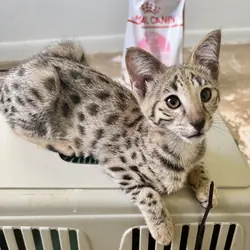
It’s time to end scraping and scrubbing with Arm & Hammer Slide Easy Clean-Up Multi-Cat Cl...
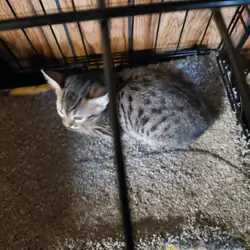
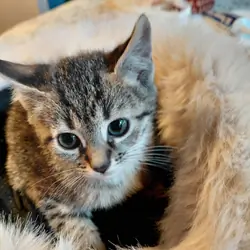
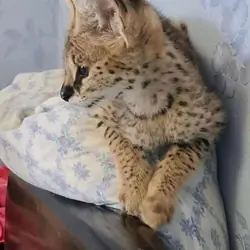
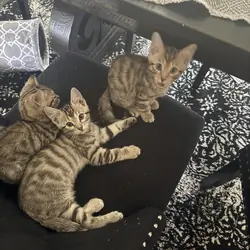
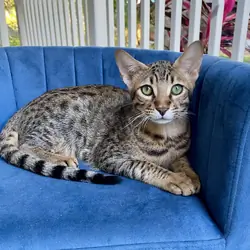
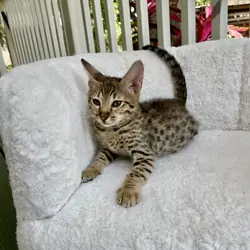
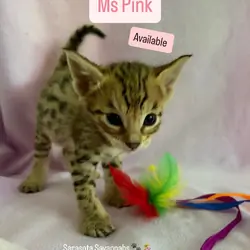
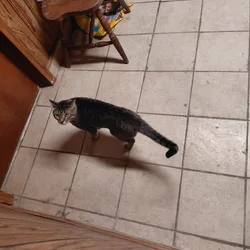
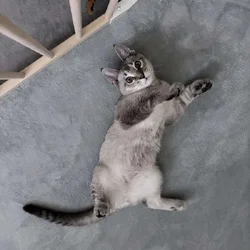

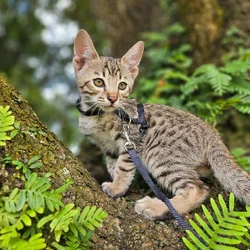
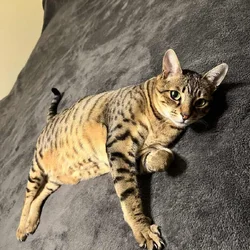
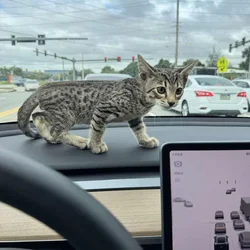


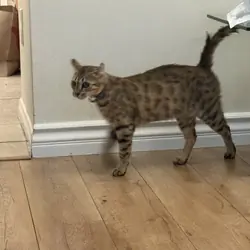
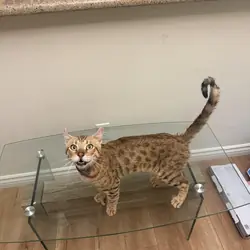
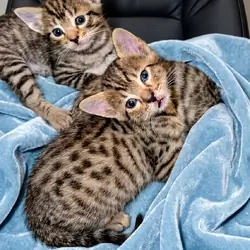
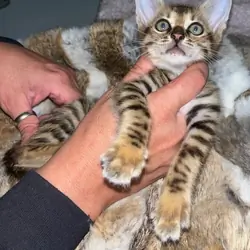
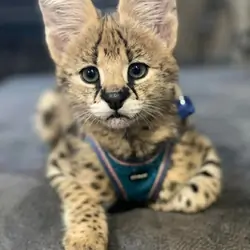
There are a couple of ways to acquire a wild-looking cat without owning a dangerous feline. Besides the Bengal, the Savannah is the most successful domesticated hybrid bred to possess the exotic and unusual appearance of an African serval. In this way, you can have a beautiful spotted pet without worrying about destruction in your home or life-threatening injuries. However, Savannah cats still require a few considerations that make them less than ideal for some families.
While the Maine Coon gets credit as the most giant purebred domesticated cat, the Savannah Cat is bigger. However, the Savannah Cat for sale is still considered a hybrid, although many have several generations of Savannah-to-Savannah breeding behind them.
Savannah Cats were named after the first of their kind. Savannah was the kitten that resulted from the initial accidental or experimental (unclear which) breeding of a Serval to a Siamese by Judee Frank in 1986. Suzi Mustachio acquired the kitten and later bred her to an Angora. A female f2 Savannah Cat for sale from this cross ended up in the hands of Lori Buchko. She matched the female with yet another domesticated cat and sold a kitten to Patrick Kelley. Kelley became instrumental in getting the Savannah Cat approved by Tica along with Lorre Smith and Joyce Sroufe, both avid Bengal Cat breeders. Sroufe also had experience with African servals and helped Kelley formulate a breed standard for the Savannah Cat. The final piece of the puzzle was Gary Fulgham with his strong social media presence and close association with f1 Savannah Cats for sale and their breeders. TICA accepted the Savannah Cat for registration in 2001, and the breed attained championship status in 2012.
Like hybrid dogs, Savannah Cats have each generation designated by "f" followed by a number. The number indicates how far removed a Savannah Cat is from the Serval. Although Servals were kept as pets as far back as the Egyptian civilizations, they became semi-tame but never domesticated. Even f1 Savannah Cats are remarkable for their affection and tendency to form strong bonds with their owners.
Your cat's filial number or generation is relevant to potential regional restrictions. Savannah Cats are illegal in some form or another in at least 10 US states. A few states like Hawaii ban the breed outright. Others only allow you to own a Savannah cat with appropriate permits. Still, others accept f4 Savannah Cats for sale as pets. Later generations are also acceptable. A breeder may combine add an alphabetic designator to further qualify their Savannah kittens for sale.
A few examples of the combination shorthand follow:
You will generally see only filial designators (f1-f5 and higher) for Savannah kittens for sale as the other qualifiers are more important for breeders and studbooks.
The ideal Savannah Cat should look like a miniature African serval and act like one of the social and outgoing domestic cat breeds. You should notice disproportionately long legs that make the cat look exceptionally tall. Likewise, the neck should be long and elegant. By contrast, a Savannah cat's tail is short, reaching a level just below the hocks. Other desirable characteristics follow:
A Savannah cat has a short, plush, soft dual coat. The first aspect of its color should be a dark tear stain from the inner corner of the eye alongside the muzzle like that of a cheetah. There are four acceptable colors for the show ring:
Other colors are chocolate, lavender, snow (very pale with dark markings), blue, cinnamon, fawn, or white.
In general, Savannah cats are active, exceptionally intelligent, friendly, and sociable with an exceedingly high prey drive. Savannah Cats, like Bengal Cats and wolfdogs, exhibit wild traits that are tied to their filial ranks. Early-generation cats can be shy and reclusive, especially with those outside their chosen people. They are not as adaptable to change as f3s and higher and need much more space and exercise. Later-generation Savannah Cats (f4 and higher and most f3s) are social with children, dogs, other cats, and visitors. Savannah cats typically like to run, interact with you, jump, and play. F1 and f2 cats are not lapcats and do not like you to hold them. F4s and f5s are much more likely to tolerate some cuddling but still prefer to stay active.
In general, f1 Savannah cats are the largest of the group and most resemble their wild forbearers. They are aloof or shy with strangers and only bond with one or two people. They are not suitable for children. People who have experience with both breeds remark that f1 Savannah cats are more sociable and manageable than f1 Bengal cats. F1 Savannahs are 13 to 41+ pounds and stand 16 to 20 inches tall at the shoulders. They are 20 to 25 inches long excluding the tail. Because they most resemble the wild serval and are more difficult to acquire and keep, f1 Savannah kittens for sale are the most expensive at up to $20,000.
Second-generation Savannah cats are unsurprisingly more social than f1s. They bond with all family members, are tolerant of respectful children, and will eventually warm up to guests visiting your home. They are 12 to 30 pounds (most are under 25 pounds) and 15 to 18 inches tall. About 20% of the f2 Savannahs are reclusive or stand-offish like the f1s. Their purchase prices range from $3,500 to $11,000.
Many fanciers feel the f3 Savannah cat for sale embraces the best of two worlds. By the third generation, the cats are affectionate and become strongly bonded with their families. Many will even deign to sit on your lap. While they make excellent family pets, f3s also retain most of the wild look that makes them so appealing. Your f3 Savannah cat will be 13 to 16 inches tall and weigh 10 to 20 pounds. These cats are about 16 to 18 inches long in body. Expect to pay $1,500 to $6,000 for f3 Savannah kittens for sale.
There is little difference between an F4 Savannah cat for sale and an F5. They are generally more social even than f3s but livelier than most domesticated cats. They occasionally command higher prices than f3s because they are more often used in breeding programs. Check your state's bylaws because a few have only legalized f4 Savannah cats and beyond. New York requires a Savannah Cat to be an f5 or higher.
Sponsored picks
Affiliate disclosure: purchases made through these links may earn PetClassifieds a commission.
It’s time to end scraping and scrubbing with Arm & Hammer Slide Easy Clean-Up Multi-Cat Cl...
Your cat deserves a high-quality, gourmet entree at every mealtime, so serve them Purina F...


